
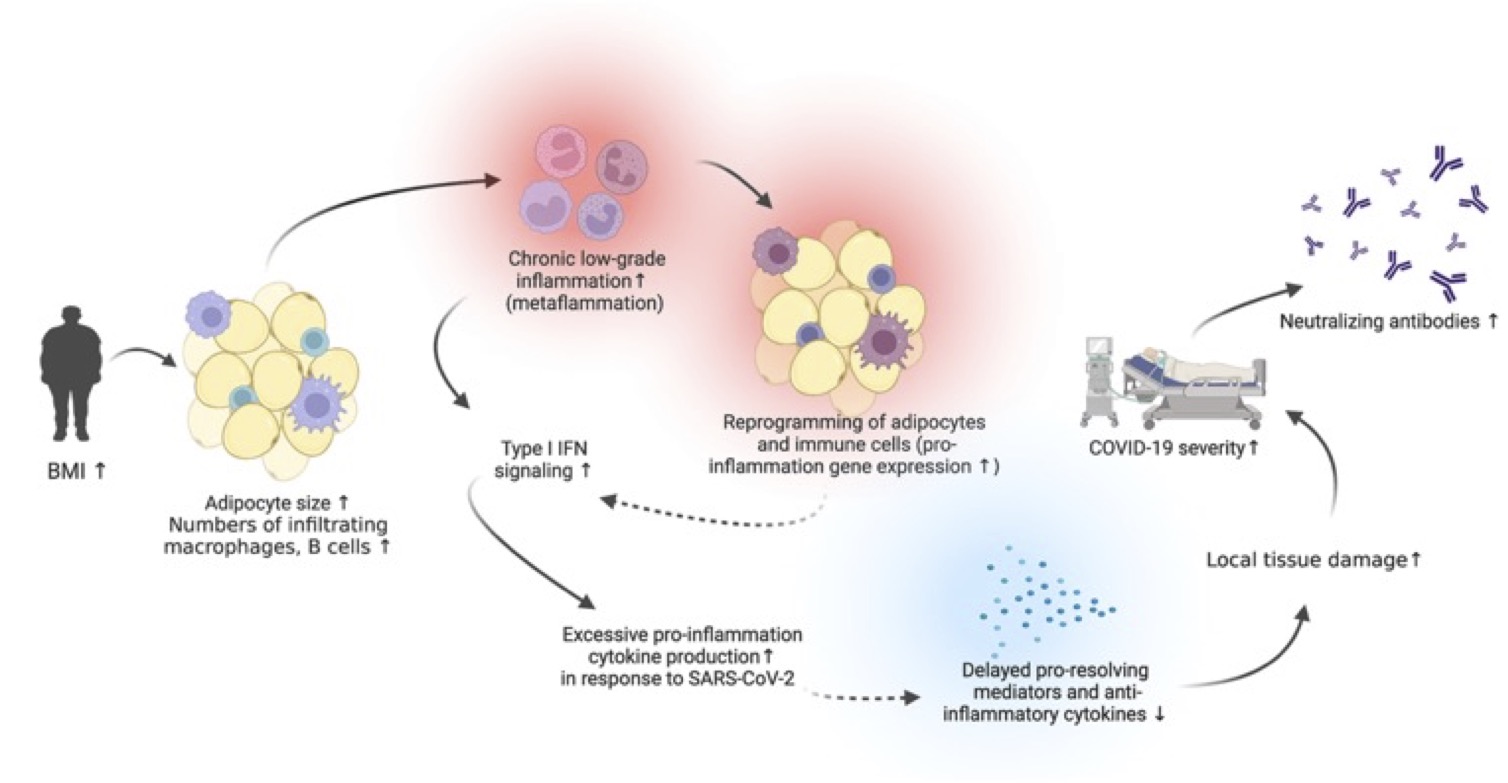
Underlying metabolic comorbidities as risk factors of SARS-CoV-2 infection risk and COVID-19 severity
Are there more effective, tailored approaches for preventing and treating diverse COVID-19 subphenotypes and comorbidities? Our recent projects have focused on determining the influences of cardiometabolic health patterns (e.g., intraindividual variability) on the risk of SARS-CoV-2 infection after vaccination, severe COVID-19, and long COVID. Figure from DOI: 10.1016/j.advnut.2023.06.003 and created with www.BioRender.com.
Selected Publications:
- Yu EA, Jackman RP, Glesby MJG, KMV Narayan. Bidirectionality between Cardiometabolic Diseases and COVID-19: Role of Humoral Immunity. Adv Nutr, 2023. 14(5): 1145 – 1158. DOI: https://doi.org/10.1016/j.advnut.2023.06.003.
- Yu EA, Stone M, Bravo MD, Grebe E, Bruhn RL, Lanteri MC, Townsend M, Kamel H, Jones JM, Busch MP, Custer B. Associations of Temporal Cardiometabolic Patterns and Incident SARS-CoV-2 Infection Among U.S. Blood Donors With Serologic Evidence of Vaccination. AJPM Focus, 2024. 3(2):100186. DOI: 10.1016/j.focus.2024.100186.
- Busch MP, Stramer SL, Stone M, Yu EA, Grebe E, Notari E, Saa P, Ferg R, Manrique IM, Weil N, Fink RV, Levy ME, Green V, Cyrus S, Williamson PC, Haynes J, Groves J, Krysztof D, Custer B, Kleinman S, Biggerstaff BJ, Opsomer JD, Jones JM. Population-Weighted Seroprevalence From Severe Acute Respiratory Syndrome Coronavirus 2 (SARS-CoV-2) Infection, Vaccination, and Hybrid Immunity Among US Blood Donations From January to December 2021. Clin Infect Dis, 2022. 75(Supplement_2):S254-S263. DOI: 10.1093/cid/ciac470.
- Yu EA, Bravo MD, Avelino-Silva VI, Bruhn RL, Busch MP, Custer B. Higher intraindividual variability of body mass index is associated with elevated risk of COVID-19 related hospitalization and post-COVID conditions. Int J Obes , 2024. 48, 1711–1719. DOI : 10.1038/s41366-024-01603-6