
In this issue of Blood Transfusion, Karafin et al.1 describe a study protocol to measure transfusion outcomes in chronic transfusion recipients in the US and Brazil. This observational trial includes patients with thalassemia and sickle cell disease (SCD), and children with hematology-oncology diagnoses. A range of hemoglobin (Hb) measures and markers of iron metabolism, hemolysis, and inflammation were measured before and after sequential transfusions in recipients. In addition, transfusion-focused genotyping was performed on blood donors and recipients, and donor/donation data were linked to the recipient outcomes.
Defining transfusion effectiveness has proved to be a challenging task across multiple patient populations. In acute illness or hemorrhage, important parameters include hemoglobin increment (easy to measure) and 24-hour post-transfusion recovery, i.e. RBC survival, and brain and tissue oxygenation (more difficult to measure). Furthermore, these measures are all proxy measures, since what we as clinicians care about is patient survival and prevention of morbidity. Even randomized clinical trials measuring parameters such as the Hb threshold for transfusion can be difficult to interpret due to heterogeneity of transfusion recipient populations2. Chronically transfused patients offer a population with known complications from repeated transfusion. While RBC transfusion has largely prevented childhood mortality from β-thalassemia major, RBC alloimmunization and iron overload remain significant causes of morbidity in these patients3. Similarly, chronic RBC transfusion has been shown to prevent stroke in children with SCD at high risk4, though again RBC alloimmunization and iron overload remain concerns in this population.
Clearly a key goal to advance effectiveness of clinical care in chronically transfused populations would be to identify blood donor factors that would allow longer intertransfusion intervals, thereby decreasing exposure to RBC transfusions and decreasing RBC alloimmunization and iron overload risks. Karafin et al. have completed a study that collected the samples and data to identify donor and component factors that predict important RBC transfusion outcomes in the RBC-IMPACT study. The study design to collect pre- and post-transfusion samples from serial transfusion episodes for each patient will allow the calculation of Hb increments and RBC survival relative to inter-donation intervals, after repeated transfusions, as well as through tracking levels of hemoglobin A (HbA) in sickle cell patients. This is a significant strength of the study design, as it has been shown that RBC storage characteristics correlate more strongly with 30 or 90-day RBC survival than with 24-hour post-transfusion recovery5, meaning that 24-hour survival does not necessarily translate to long-term persistence of transfused RBCs. For a chronically transfused population, the average decrement in hemoglobin between transfusions would be the more important parameter to follow in an effort to decrease exposure to iron through repeated transfusion events.
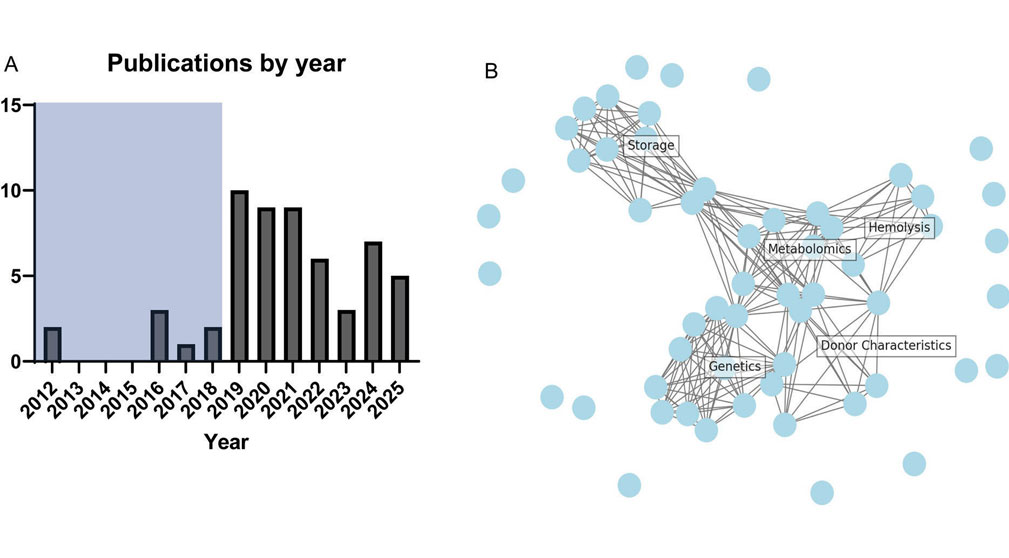
A second strength of the study by Karafin et al. is the “vein-to-vein” linkage of donor and component data with recipient characteristics and outcomes in the REDS-IV-P programs in the US and Brazil that the RBC-IMPACT study was embedded in. Early US vein-to-vein databases expanded on the vision first developed 20 years ago by the ScanDat program that executed linkage of donor and recipient datasets in Sweden and Denmark to inform donor determinants of recipient disease outcomes6-8. The earlier US databases and linked sample repositories were focused on tracing transfusion-transmitted infections9,10, while later iterations in the Recipient Epidemiology Donor Study (REDS)-III and REDS-IV-P (pediatric) shifted focus to emphasize analysis of non-infectious complications and outcomes after transfusion11,12. The REDS-III RBC omics program provided multiple new insights into blood donor and component inf luence on outcomes such as hemoglobin increment or need for repeat transfusion, and changes in bilirubin (a marker of hemolysis) or creatinine (a marker of kidney function) after transfusion13. The RBC-omics study from REDS-III proved to be highly productive, with over 50 manuscripts linking genetics, metabolomics, and blood storage with transfusion outcomes such as post-transfusion hemoglobin increment (Figure 1)14. Notably, the repository and database generated during REDS III allowed productivity extending long beyond the formal funding period of REDS III. However, these analyses were largely focused on donor demographic andgeneticcorrelates of RBChemolysisandmetabolomics during blood component storage while recipient outcomes were limited to shorter, in-hospital outcomes. The RBC-IMPACT trial will allow measurement of transfusion effectiveness over longer periods across multiple transfusions in a given individual.
Both REDS-III and REDS-IV-P included genotyping of blood donors, with RBC-Omics using an array of 879,000 single nucleotide polymorphisms (SNPs)15, while the REDS-IV-P RBC-IMPACT program is using a more targeted “precision transfusion medicine array” comprised of ~20,000 SNPs to test the US donor and recipient samples16. The most obvious benefit of genotyping blood donors from a clinical perspective would be to improve RBC antigen matching accuracy and lower cost16,17, particularly for transfusion recipients most at risk of RBC alloimmunization18, such as SCD patients19. Large-scale genotyping of blood donors would also afford numerous basic science discoveries. A recent genome wide association study (GWAS) using over 12,000 blood donors revealed 27 significant genetic loci associated with in vitro measures of hemolysis following blood storage, and 7 of these were also identified as associated with in vivo hemolysis in SCD patients20. Many additional loci that correlated with in vitro RBC function and in vivo RBC survival were identified by integrating metabolomic and GWAS data through quantitative trait (mQTL) analyses21. Perturbations of RBCs during storage, such as energy depletion22, lipid peroxidation23, or failure to mitigate oxidative stress24, contribute to suboptimal storage quality and impaired transfusion ef ficacy. Moreover, the REDS RBC-Omics group has advanced the concept of the blood donor exposome25, highlighting how donor exposures −including many not subject to current deferral criteria− may influence storage outcomes as much as, or more than, storage duration. These insights have been instrumental in reframing the concept of “storage age” from a chronological to a metabolic perspective.
The current study by Karafin et al. will extend these earlier findings by focusing on in vivo RBC survival and hemolysis markers across a large population of 5,162 unique blood donors’ samples. By performing genetic association studies with the primary clinical endpoints of changes in Hb and HbA increments over time, the study will be able to identify novel SNPs potentially associated with RBC survival but not necessarily storage-associated hemolysis. It is expected that many novel research hypotheses will arise from the planned donor and recipient genetic, metabolomic, and other biomarker analyses, advancing the frontier of personalized transfusion medicine.